In modern RF and antenna applications—especially in satellite communication, 5G systems, and high-frequency devices—PCB material selection plays a critical role in overall performance.
Among various parameters, dielectric constant (Dk) and copper surface roughness (Rz) stand out as two core indicators, which directly determine signal integrity and signal transmission efficiency.
1. The Importance of Low Dk Materials
Low Dk materials (typically in the range of 2.0–2.5) have become the preferred option for antenna and high-frequency RF circuit design.
The excellent performance is reflected in the following aspects:
- Lower signal delay
- Reduced dielectric loss
- More stable impedance control
- Higher antenna radiation efficiency
These merits are particularly vital for high-frequency scenarios represented by satellite antennas. Even minor signal loss will greatly weaken the overall operating performance of the device.
2. Why Copper Roughness Matters
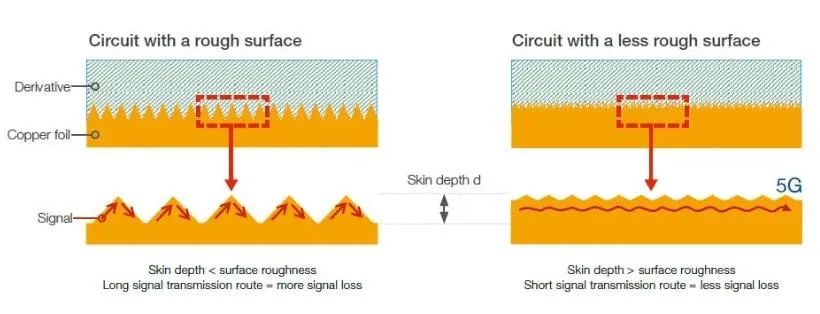
Copper surface roughness (Rz) is easily ignored in conventional PCB design, yet it exerts a decisive influence on high-frequency signal transmission.
As the operating frequency rises, electric current mainly flows along the surface of the copper conductor, which is known as the skin effect in high-frequency electronics.
Rougher copper surfaces will extend the signal transmission path and inevitably bring extra signal loss.
For this reason, low roughness copper foil with Rz ≤ 3μm has become the standard configuration for high-end RF PCB designs.
3. What Are the Main Challenges of High-Frequency PCB Materials?
PTFE and other high-performance laminates can provide ideal high-frequency electrical properties, but they also have obvious practical limitations in mass production:
- Relatively high material cost
- Complicated fabrication and processing requirements
- Ordinary mechanical stability and process compatibility
To strike a balance between technical indicators and budget, most engineers adopt hybrid stack-up designs to optimize overall project cost-effectiveness.
4. What is the Best Material Selection for RF & Antenna PCB?
Based on rich project experience in RF and antenna PCB manufacturing, we have summarized mature matching standards for general high-frequency applications:
- Dielectric constant (Dk): 2.2 – 2.5
- Copper surface roughness: ≤ 3μm
- Adopt hybrid laminate stack-up when cost control is a priority
This matching scheme perfectly satisfies high-frequency performance requirements while effectively controlling project budget and production risks.
5. Conclusion
The selection of RF PCB materials is never a simple compliance check of electrical parameters. It is a comprehensive trade-off among high-frequency performance, manufacturability and overall cost.
If you are working on RF or antenna designs and are unsure about material selection, working with an experienced PCB partner can significantly reduce risks and improve your final results.
At Jerico, we provide professional PCB stack-up optimization and high-frequency material selection consulting for global customers.
Feel free to contact our technical team anytime to evaluate your design scheme or get customized cost-effective material alternatives.