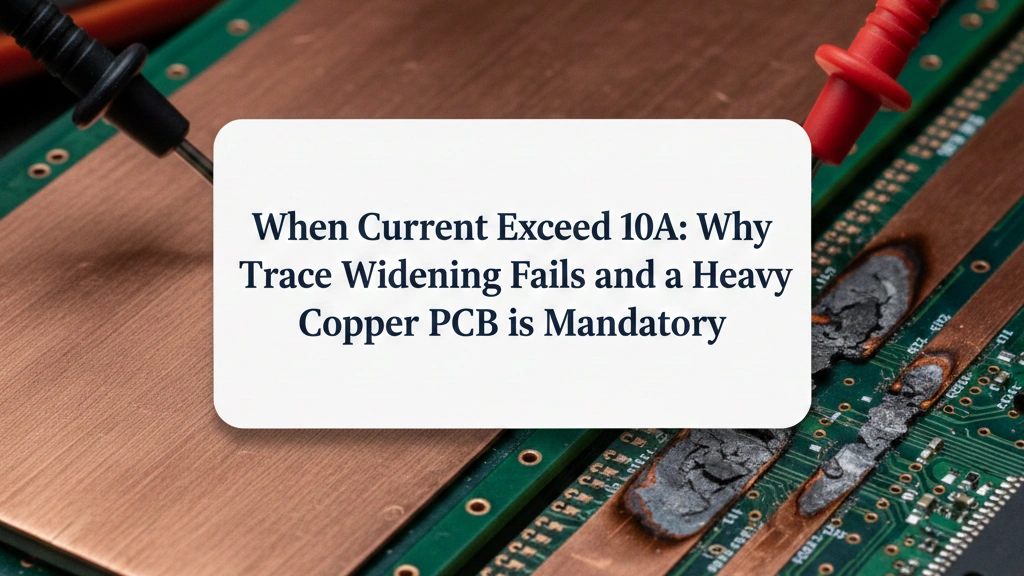
For power design engineers pushing the limits in electric vehicles, server racks, or industrial drives, a common and costly assumption persists: to carry more current, simply widen the copper trace. However, when currents surpass the 10A threshold, this approach not only fails but can actively undermine reliability. This article moves beyond basic IPC-2152 charts to dissect the fundamental physics—skin effect and three-dimensional thermal accumulation—that render simple 2D trace widening ineffective. We will demonstrate how transitioning to a Heavy Copper PCB design is not merely an upgrade but a necessary paradigm shift for managing high current density, ensuring thermal stability, and achieving long-term reliability in demanding applications.
The Failure of “Wider is Better”: Real-World High-Current Breakdowns
The transition from moderate to high current (typically >10A continuous) marks a shift in failure modes. Problems are no longer just about DC resistance but about power density and the inability to dissipate generated heat.
Case Study: Drone ESC Burn-Out
Scenario: A 15A continuous current Electronic Speed Controller (ESC) for a commercial drone. The engineer specified a 5mm wide power trace using 1oz (35μm) copper, believing it was sufficient based on a simplified DC calculation.
Failure: During a high-ambient-temperature flight test, the PCB showed localized discoloration (yellow/brown) on the trace, followed by blistering and eventual open-circuit failure, causing motor shutdown.
Root Cause Analysis: The wide, thin trace had a large surface area but minimal cross-sectional volume. The current generated heat faster than it could be conducted away through the thin copper and the underlying low-thermal-conductivity FR4 (≈0.3 W/m·K). This created a localized hotspot exceeding the substrate’s glass transition temperature (Tg), leading to delamination and failure.
Case Study: Server PSU Capacitor Life Reduction
Scenario: A 30A power distribution layer on a server power supply unit (PSU) motherboard. The 2oz internal plane was deemed adequate for current capacity.
Failure: Units in the field showed a 50% higher failure rate after 18 months. Analysis revealed premature drying of electrolytic capacitors positioned near the high-current input section.
Root Cause Analysis: The sustained high current caused the PCB substrate temperature near vias and connectors to consistently operate above 105°C. This ambient heat baked the adjacent capacitors, drastically accelerating electrolyte evaporation and reducing their operational lifespan. The board carried the current but failed to manage the resultant thermal byproduct.
The Physics Behind the Failure: More Than Just Resistance
To understand why trace widening hits a wall, we must examine the two dominant physical phenomena that take over at higher currents and frequencies.
1. The Skin Effect: Current Avoids the Center
At DC, current distributes evenly across a conductor’s cross-section. As frequency increases—including the fundamental switching frequencies and harmonics in power electronics (e.g., 100kHz to 1MHz+)—the skin effect forces current to flow primarily on the conductor’s outer surface.
- Skin Depth (δ) is the depth where current density falls to about 37% of its surface value. It is inversely proportional to the square root of frequency (f).
- For copper at 100kHz: δ ≈ 0.21mm. At 1MHz: δ ≈ 0.066mm.
Critical Implication: A wide, 1oz-thick (0.035mm) trace is already thinner than the skin depth at 100kHz. Widening it does nothing to increase the effective conducting cross-section for AC currents; it merely creates a wider, underutilized surface. The AC resistance (RAC) becomes significantly higher than the DC resistance (RDC), leading to unexpected I²R heating.
2. Thermal Accumulation: The Third-Dimension Trap
This is the primary failure mode for DC and low-frequency high currents. Joule heating (I²R) generates thermal energy within the trace volume.
- The Problem: Standard 1oz or 2oz copper is thin. Heat generated has a very short path vertically into the poorly-conductive FR4, trapping it.
- Widening Exacerbates the Issue: A wider trace increases the thermal mass slightly but also spreads the heat source over a larger area, making it harder to localize cooling and often raising the average temperature of a larger PCB zone.
- The Via Bottleneck: High-current paths often change layers. A standard 0.3mm plated through-hole (PTH) has limited current capacity (often <1A). An array is needed, but each via is a point of higher resistance and a thermal choke point, creating localized “volcano” hotspots prone to cracking and failure under IATF 16949 thermal cycling tests.
The Core Limitation
Trace widening addresses a 2D problem (current density in plane view) but ignores the critical 3D problem of heat dissipation through the board’s thickness and into the system. It increases copper area but not copper volume proportionally, which is key for both current carrying (reducing DC resistance) and thermal mass (absorbing and spreading heat).
The Heavy Copper PCB Solution: A Fundamental Shift in Design
Heavy Copper PCBs (typically defined as employing 3oz/105μm to 20oz/700μm copper weights) solve these problems by operating in the third dimension from the start.
| Design Challenge | Trace Widening (1-2oz) Response | Heavy Copper PCB (3oz+) Response | Mechanism & Advantage |
|---|---|---|---|
| High DC Current (>10A) | Requires excessively wide traces, consuming routing area. High DC resistance per unit length. | Carries same current in a much narrower trace. Drastically lower DC resistance. | Increased Cross-Sectional Area: Current capacity scales with trace thickness. A 3oz trace has 3x the copper volume of a 1oz trace of identical width, directly reducing RDC and I²R losses. |
| Skin Effect (AC Losses) | Ineffective. Widening does not increase usable thickness below skin depth. | Significantly mitigates impact. Provides more conductive material within the effective skin depth. | Vertical Conductor Dimension: Even with skin effect, a 10oz (0.35mm) copper layer provides substantial usable thickness at high frequencies, keeping RAC low. |
| Thermal Management | Poor. Thin copper cannot spread heat; FR4 substrate traps it, creating hotspots. | Excellent. Copper layer acts as an integrated heat spreader. | Copper as a Heat Sink: Copper’s high thermal conductivity (≈400 W/m·K) allows heat to spread laterally and be conducted to vias or heatsinks. Increases thermal mass, slowing temperature rise. |
| Mechanical & Via Reliability | Vias are weak points. High thermal stress can cause barrel cracking. | Enables robust via structures: filled, plugged, or with thicker plating. | Enhanced Structures: Supports copper-filled vias for low-resistance, high-thermal-conductivity interconnects. Withstands thermal cycling per IPC Class 3 and automotive standards. |
Quantifying the Difference: A Simple Comparison
Consider a 10A DC continuous current with a target 20°C temperature rise (per IPC-2152):
- Using 1oz (35μm) Copper: Required external trace width ≈ 2.5 mm.
- Using 3oz (105μm) Copper: Required external trace width ≈ 0.8 mm.
The Heavy Copper PCB implementation saves over 65% in precious board area for the same current, enabling more compact and higher-density power designs.
Integrating Heavy Copper with Other Advanced Technologies
Heavy copper is often the cornerstone of a complete thermal and high-power management strategy. Jerico’s expertise lies in integrating it seamlessly with other technologies.
For Extreme Localized Cooling
Heavy Copper + Metal Core or Ceramic Substrate.
Use an internal heavy copper layer for current distribution and pair it with a Metal Core PCB (MCPCB) or Ceramic PCB under high-power devices (e.g., LEDs, IGBTs). The heavy copper handles the current, while the specialized substrate provides a dielectric yet highly thermally conductive path to the chassis.
For High-Density Power + Signal
Heavy Copper Inner Layers + HDI.
In complex systems like automotive controllers, use HDI technology for fine-pitch components and high-speed signals on outer layers, while dedicating internal layers to 4oz+ copper for robust, low-inductance power busing and thermal planes.
For Complex 3D Assembly
Heavy Copper in Rigid-Flex.
A Rigid-Flex PCB might employ heavy copper in the rigid power supply sections for current handling, while the flexible interconnects allow for compact packaging in space-constrained applications like robotics or aerospace.
Why Jerico is Your Partner for High-Current PCB Success
Designing with heavy copper requires more than a CAD library change; it requires a manufacturer with specialized process mastery.
Mastery of Complex Fabrication
Etching and laminating thick copper foils (e.g., 10oz) presents unique challenges:
- Controlled Etch Factor: To achieve precise trace width, we employ differential etching techniques that account for significant sidewall etching, preventing over-etching and maintaining the designed cross-sectional area.
- Reliable Multi-Layer Lamination: The high mass of copper can lead to resin flow issues during pressing. Our IATF 16949-certified process controls, including specialized prepregs and optimized lamination cycles, ensure perfect bonding and void-free construction, critical for IPC Class 3 reliability.
- Advanced Via Treatment: We offer and expertly execute copper-filled and capped vias, turning thermal and current bottlenecks into high-performance conduits. This is a standard offering in our Heavy Copper PCB service.
Factory-Direct Efficiency
As a true factory-direct manufacturer, Jerico removes broker markups and communication filters. You get:
- Accurate Technical Feedback: Our engineers review your design directly, suggesting optimizations for manufacturability and performance.
- Cost-Effective Scaling: Transparent pricing from prototype, supported by our No MOQ policy, to volume production on our 60,000㎡ monthly capacity lines.
Speed to Market
We understand the pace of innovation:
- Rapid Prototyping: For urgent development cycles, we offer 24-hour quick-turn services on heavy copper prototypes, allowing you to test and validate thermal performance immediately.
- One-Stop Solution: Whether your high-current design also needs RF sections (High Frequency PCB) or embedded components (Cavity PCB), Jerico provides a unified manufacturing source, simplifying your supply chain.
Stop Simulating, Start Validating with a Real Heavy Copper PCB
Theoretical calculations can only go so far. Partner with Jerico to transform your high-current design into a reliable, manufacturable product.
Upload Your Design for a Free DFM & Current AnalysisOur engineering team will provide a detailed report on current density, thermal hotspots, and recommend the optimal heavy copper stackup for your application.
High-Current PCB Design: Expert FAQ
There’s no single universal threshold, but 10A continuous current is a strong practical indicator to evaluate heavy copper. Consider it mandatory when:
- Your calculated trace width for a 20°C temperature rise exceeds 3-4mm on outer layers or 6-8mm on inner layers (for 1oz copper).
- Your application involves high ambient temperatures (e.g., >70°C) or requires low temperature rise for component longevity.
- The design is space-constrained, and wide traces are consuming excessive routing area.
- The operating frequency has significant harmonics above 50kHz, where skin effect starts to diminish the effectiveness of thin copper.
A Jerico DFM analysis can pinpoint the exact crossover point where heavy copper becomes more cost-effective than oversized standard-copper layouts.
Vias are the weak link in high-current design. With heavy copper, you have superior options:
- Via Arrays, Not Single Vias: Always use multiple vias in parallel to share current. A good rule of thumb is to not rely on a single via for more than 1-2A.
- Specify Copper-Filled/Plugged Vias: This is critical. Request “VIPPO” (Via-in-Pad Plated Over) or fully copper-filled vias. This massively increases the via’s current-carrying cross-section and turns it into a thermal column. Jerico routinely provides this for Heavy Copper PCBs.
- Increase Annular Ring Size: For heavy copper layers, specify a larger annular ring (e.g., 0.2mm over standard) to ensure a robust connection to the thick plane and account for any potential registration shift during lamination.
- Thermal Reliefs: Often, for connections to internal heavy copper planes, solid connections (no thermal relief) are preferable for both current and thermal transfer, unless soldering issues arise.
It increases the board-level cost but often decreases the system-level total cost of ownership (TCO).
- Board Cost Increase: Yes, raw material (copper clad laminate) costs are higher. The specialized etching and lamination processes also add cost. A 4oz board may cost 1.5x to 2x a similar 1oz board.
-
System Cost Savings:
- Reduced Layer Count: By carrying current efficiently, you may avoid adding extra power planes, potentially reducing overall layer count.
- Improved Reliability: Eliminates field failures due to thermal overstress, saving on warranty, repairs, and brand reputation damage.
- Smaller Form Factor: Enables more compact designs, reducing enclosure and system size/cost.
- Simplified Thermal Management: May reduce or eliminate the need for auxiliary heatsinks, fans, or thermal interface materials.
For mission-critical industrial, automotive, or aerospace applications where failure is not an option, the reliability dividend of heavy copper far outweighs the initial PCB premium.