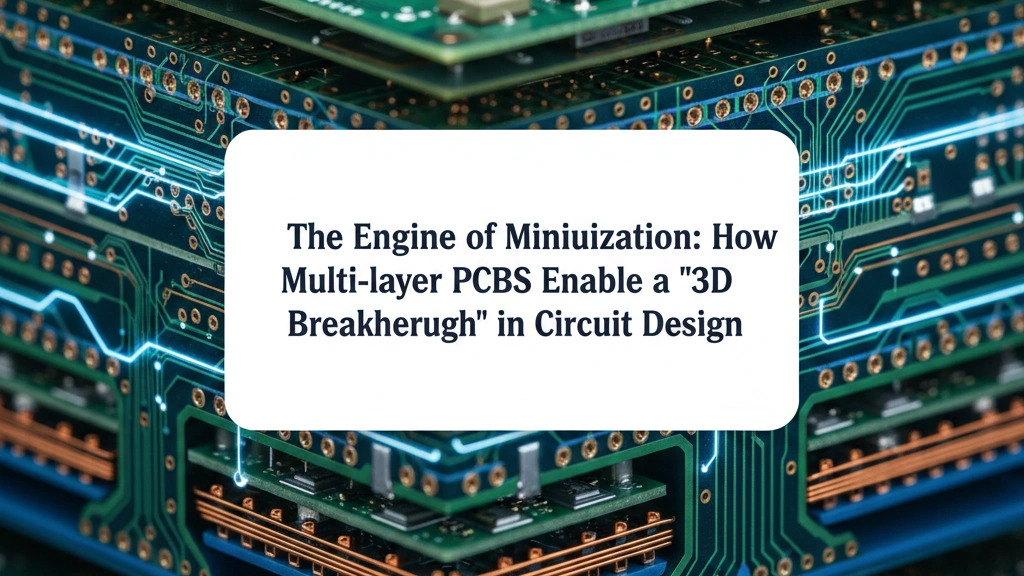
For hardware engineers and product managers, the relentless drive for smaller, lighter, and more powerful devices creates a fundamental design paradox: how to pack more functionality into less space without compromising performance, signal integrity, or thermal management. The traditional two-dimensional PCB approach hits an absolute wall. This article explores how multi-layer PCB technology—and its advanced evolutions like HDI and rigid-flex—represent not just an incremental improvement, but a paradigm shift into the third dimension. By strategically utilizing the Z-axis, engineers can break free from the “impossible triangle” of size, function, and performance, transforming compact, complex designs from theoretical challenges into manufacturable realities with partners like Jerico.
The “Impossible Triangle” of 2D PCB Design
In a world constrained to two copper layers, designers face a brutal trade-off. Attempting to optimize one vertex of the triangle—**Size, Functionality, or Performance**—inevitably degrades the others. This is the core limitation of double-sided PCBs that halts miniaturization.
| Design Goal | Consequence on a 2D Board | Real-World Project Impact |
|---|---|---|
| Reduce Size / Weight | Forces narrower traces, closer component spacing. Increases crosstalk, reduces current capacity, complicates routing to the point of impossibility for complex circuits. | Smartwatch Design: A 28mm circular board cannot route a modern system-on-chip (SoC), memory, sensors, and antenna feedlines on two sides. Critical antenna keep-out zones are violated, or battery size is compromised, killing the product’s core value. |
| Add More Functions | Requires more components and traces, pushing designers to increase board area (defeating miniaturization) or creating dense, noisy layouts with severe EMI and thermal issues. | Drone Flight Controller: Adding GPS, multiple IMUs, and obstacle avoidance sensors forces the use of multiple sub-boards connected by cables and connectors. This increases weight, reduces reliability at vibration-prone solder joints, and raises assembly costs by 30% or more. |
| Enhance Electrical Performance (High-Speed, Power) | Wide power traces and controlled impedance lines for high-speed signals consume vast areas, leaving little room for other functions. Clear separation of analog, digital, and RF sections becomes unfeasible. | Optical Transceiver Module: 100G+ designs require pristine, isolated channels for differential pairs. On a 2D board, these sensitive lines are forced to cross or run parallel to noisy power rails, causing intolerable jitter and bit errors that simulation cannot fully predict or eliminate. |
The only way to solve this is to escape the 2D plane. Multi-layer PCB technology is that escape hatch, providing a **third dimension** for design.
The 3D Breakthrough Strategy: A Layered Approach to Miniaturization
Breakthrough #1: Vertical Stacking – Creating Dedicated Functional Channels
The foundational power of a multi-layer rigid PCB is its ability to segregate functions into dedicated layers, much like building a multi-story car park instead of a single massive lot.
- Signal Integrity (SI): High-speed digital lines (e.g., DDR4, PCIe) are routed on internal **stripline layers**, sandwiched between solid ground and power planes. This provides natural EMI shielding, controlled impedance, and prevents crosstalk from other circuit blocks.
- Power Integrity (PI): Dedicated, thick **power planes** offer extremely low-impedance distribution, reducing voltage drop and noise across the board, which is critical for modern FPGAs and processors with fast switching currents.
- EMC & Grounding: Continuous **ground planes** provide a stable reference and a low-impedance return path for signals, drastically reducing electromagnetic emissions and improving immunity.
Density Multiplier: A standard 6-layer board effectively provides 4 routing layers. In the same footprint as a double-sided board, this offers a **100%+ increase in available routing channels**, all while improving electrical performance. This is the first step in the 3D revolution.
Breakthrough #2: Precision 3D Interconnects – The HDI Revolution
When component density pushes further—with 0.4mm pitch BGAs and 0201 components—standard through-vias (which pierce all layers) become obstacles themselves. High-Density Interconnect (HDI) technology is the answer.
Jerico’s HDI PCB capabilities enable this through microvias and sequential lamination:
Microvias (<0.15mm)
Laser-drilled, these tiny vias connect adjacent layers. Their small size allows them to be placed directly within component pads (Via-in-Pad), freeing up 100% of the surface area for routing. This is essential for escaping fine-pitch BGA devices.
Blind & Buried Vias
These vias connect only specific layers (e.g., L1-L2 or L3-L5), never traversing the entire board. They eliminate long, unused “stubs” that harm high-speed signal integrity and free up every other layer for independent routing, maximizing usable space in all three dimensions.
An 8-layer HDI board with “1+N+1” or “2+N+2” construction can achieve the routing density of a 12+ layer conventional board, in a thinner, lighter, and higher-performing package.
Breakthrough #3: Structural Integration – Cavity and Embedded Technology
When the Z-axis height is the limiting factor, true 3D integration begins. Cavity PCB technology allows components to be recessed into the board itself.
- Process: A precision cavity is milled into the core or built up during lamination. Components like large inductors, shielded modules, or even bare dies are placed within this recess.
-
Benefits:
- Ultra-Low Profile: The overall assembly height can be reduced by the component’s own thickness, critical for wearable and mobile devices.
- Enhanced Thermal & Mechanical Performance: The cavity base can be a direct thermal path to a heat spreader. Components are protected from physical stress and vibration.
- Improved Signal Paths: Embedding RF components can shorten critical transmission lines, reducing loss at millimeter-wave frequencies.
Breakthrough #4: Hybrid Material & Form Factor Solutions
The ultimate 3D design often requires combining multiple specialized technologies into one cohesive assembly. Jerico’s “one-stop-shop” capability is critical here.
| Complex Requirement | Integrated 3D Solution | Technologies Combined | Jerico’s Role |
|---|---|---|---|
| Compact, high-power motor driver with dense control logic. | Inner-layer heavy copper (4oz+) for current, surface HDI for fine-pitch controller. | Multi-layer + HDI + Heavy Copper | Single-vendor manufacturing ensures perfect lamination of thick copper and fine features, with DFM guidance to avoid reliability pitfalls. |
| Portable medical device requiring flexibility and high density. | Rigid-Flex PCB: Rigid areas for components, flexible tails for 3D assembly. | Rigid Multilayer + Flexible Circuits | Expertise in managing different material CTEs and precise flex-rigid transition zones for long-term reliability per IPC Class 3. |
| 5G mmWave antenna module with low loss and heat dissipation. | Hybrid stackup: Rogers material for RF layers, FR4 for others, with thermal vias under PA. | High-Frequency Material + Standard FR4 + Thermal Management | Material compatibility knowledge and controlled lamination process (IATF 16949 based) prevent delamination and ensure stable Dk for consistent antenna performance. |
Why Jerico is Your Partner for 3D Miniaturization Success
Executing a complex 3D PCB strategy requires more than just a list of capabilities; it demands deep manufacturing expertise, seamless integration, and a partnership grounded in reliability.
Front-Loaded Engineering & DFM Partnership
The cost of a mistake in a 10-layer HDI or rigid-flex design is monumental. As a factory-direct partner, Jerico’s engineers engage during your schematic or early layout phase. We provide actionable stackup design, material selection, and layout rule advice tailored to our production lines, transforming your 3D concept into a manufacturable design from day one. This proactive collaboration is our standard service, not an upsell.
Certified Process Reliability
3D PCBs are unforgiving. A slight misalignment in laser drilling or a weak bond in a rigid-flex interface spells failure. Our IATF 16949 and IPC Class 3 operational discipline ensures statistical process control (SPC) for every critical step—from laser via registration to lamination pressure profiles. This certified rigor guarantees the reliability of your miniaturized product in automotive, medical, or industrial environments.
Speed & Agility from Prototype to Volume
Innovation waits for no one. Jerico’s integrated model delivers unmatched speed:
- Rapid Prototyping: 24-hour turnaround is available for multi-layer and HDI prototypes, allowing you to test fit, form, and function in days, not weeks.
- Scalable Volume: With a 60,000㎡ monthly capacity and no MOQ, we scale seamlessly from your first proof-of-concept to full-scale production without changing partners or requalifying.
- Unified Supply Chain: By consolidating complex builds (HDI, Heavy Copper, Flex) under one roof, we eliminate interface risks, reduce lead times, and provide single-point accountability.
Transform Your Miniaturization Challenge into a 3D Reality
Stop wrestling with 2D limitations. Partner with Jerico to leverage the full potential of multi-layer, HDI, and advanced PCB technologies.
Consult with Our Engineering Team for a Free Stackup ReviewShare your product requirements or preliminary design. We’ll provide a professional analysis and a roadmap to achieve your size, performance, and cost goals.
Miniaturization & Multi-layer PCB Design: Expert FAQ
Consider HDI when you encounter one or more of these thresholds:
- Component Density: You are using components with a pitch ≤ 0.5mm (e.g., fine-pitch BGAs, CSPs). HDI’s microvia-in-pad is essential for escape routing.
- Board Size Constraint: The required trace count and component count cannot be physically routed on the available board area with standard through-vias, even with 8+ layers.
- High-Speed Performance: Signal speeds exceed ~5 Gbps. HDI’s blind vias eliminate signal-degrading stubs present in through-vias, improving signal integrity.
- Form Factor: The design requires an ultra-thin profile. HDI allows for fewer sequential layers with higher routing density, potentially reducing overall thickness.
Practical Tip: Start your layout with a standard stackup. If you find yourself needing more than 2 escape layers under a BGA or the routing is impossibly congested, it’s time to evaluate HDI. Jerico’s free DFM review can provide this assessment early on.
While the PCB unit cost increases with layer count and HDI complexity, the total system cost and value often improve dramatically, making it a net gain.
- Reduced Assembly Cost: A single, complex multi-layer/HDI board can replace multiple interconnected smaller boards, eliminating connectors, cables, and multiple assembly steps.
- Higher Reliability: Fewer interconnects mean fewer potential points of failure, reducing warranty and field repair costs. This is critical for brand reputation in consumer electronics and safety in automotive/medical.
- Enabling the Product: Often, miniaturization itself is the product’s key selling point (e.g., wearables, hearables). The advanced PCB is not a cost; it’s the enabling technology that creates market value and allows for premium pricing.
- Material Optimization: With Jerico’s hybrid stackup expertise, you can use expensive high-performance materials (e.g., for RF) only where absolutely needed, and standard FR4 elsewhere, optimizing the cost-performance ratio.
Go beyond generic capabilities lists. Ask for specific proof and processes:
- “Can you provide a cross-section sample of an 8+ layer HDI board you’ve produced, and the corresponding microsection report?” This shows their actual plating quality, layer registration, and via structure.
- “What is your standard registration tolerance for laser microvias, and how is it controlled and measured?” (Jerico’s answer: Typically ±25μm, controlled via vision systems and SPC).
- “Do you have in-house rigid-flex capabilities, and can I see a reliability report (e.g., flex cycling test) for a similar design?” This assesses true integration expertise versus outsourcing the flex part.
- “How do you manage material compatibility and pressing cycles for hybrid stackups involving RF materials and FR4?” The answer should reference specific material databases and controlled lamination profiles.
- “What is your typical yield for a 10-layer HDI board with 0.1mm microvias, and what are the top three defect modes you control for?” This separates experienced manufacturers from experimenters.
Jerico welcomes these questions. Our factory-direct model means our engineers who oversee these processes can provide direct, evidence-based answers.