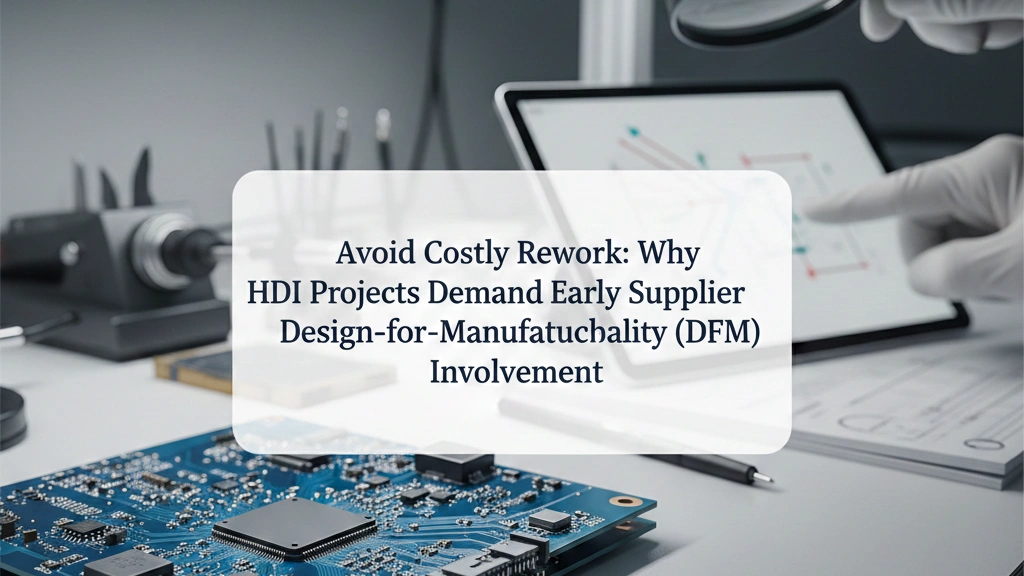
For engineers and project managers pushing the boundaries of miniaturization and performance with HDI (High-Density Interconnect) PCBs, the gap between a flawless CAD model and a reliable, manufacturable board is wider than ever. The complexity of microvias, sequential lamination, and mixed-material stackups means that traditional “design-then-verify” approaches are a direct path to budget overruns and missed deadlines. This article argues that the most critical determinant of HDI project success is not just the chosen manufacturer’s capabilities, but the timing and depth of their engineering involvement. We will dissect the costly failures that occur in the “design-manufacturing gap” and demonstrate how a proactive, collaborative DFM partnership from the earliest stages transforms risk into reliability and ensures your innovative design reaches market as intended.
The High Cost of the “Design-Manufacturing Gap” in HDI
HDI technology enables remarkable feats of integration but introduces a unique set of physical and process constraints that are often invisible within EDA software. When design intent meets manufacturing reality too late, the consequences are severe and measurable.
Failure Scenario 1: The “Unbuildable” Stacked Via
The Design: An engineer designs a dense CPU footprint using a 1-2-3 stacked microvia structure to escape a 0.35mm pitch BGA, maximizing space. The CAD design passes all electrical rule checks.
The Late-stage DFM Rejection: Upon Gerber submission, the manufacturer reports the design exceeds their laser drilling registration capability (±40µm). The sequential alignment of three microvias has a cumulative tolerance risk, predicting a capture pad reliability of less than 60%, far below IPC Class 3 requirements.
The Cost: A complete redesign of the BGA escape pattern is required. This involves respinning the entire high-speed breakout region, a 2-3 week project delay, and the risk of compromising signal integrity in the rework.
Failure Scenario 2: The Solder Wicking Catastrophe
The Design: To save space, a designer uses via-in-pad for a large BGA. The design files are sent for production with no special via instructions.
The Failure: The board is assembled. During reflow, molten solder wicks down the unfilled via barrels, starving the BGA ball joints. This results in a mix of open circuits and weak, unreliable connections.
The Cost: 100% assembly failure rate for the batch. Requires costly and damaging board rework (individual BGA removal and replacement) or a complete scrapping of assembled boards and a new PCB fabrication cycle with the correct filled via process.
The Root Cause: Asymmetric Information
The designer operates in an ideal world of perfect registration and material consistency. The manufacturer navigates a world of statistical process control (SPC), material lot variances, and equipment-specific tolerances. Traditional DFM, conducted after layout completion, is merely a failure detection step. True value is unlocked when the manufacturer’s process knowledge informs the design rules before layout begins.
What is True Early Design Engagement? Beyond the Checkbox DFM
Early supplier involvement is not about getting a quicker quote. It’s a structured, technical collaboration that shifts the manufacturer’s role from critic to co-architect.
| Engagement Stage | Traditional “Post-Design” DFM | Proactive “Early Engagement” DFM | Impact on Project |
|---|---|---|---|
| Timing | After Gerber/file generation, before tooling. | During schematic capture or preliminary layout (pre-routing). | Early engagement prevents fundamental design flaws; late DFM only finds them. |
| Primary Deliverable | A report listing violations (clearance, annular ring, etc.). | A co-design proposal covering stackup, material selection, and critical design rules. | The report is reactive; the proposal is a constructive roadmap. |
| Focus | “Can we build this file as-is?” | “What is the optimal, most reliable way to realize this design intent?” | Shifts from detection to optimization and risk mitigation. |
| Cost of Change | Extremely high. Changes require significant layout rework. | Very low. Changes are incorporated into the initial layout strategy. | The fundamental economic argument for early engagement. |
Key HDI Challenges Solved by Early Collaboration
1. Stackup Architecture: Balancing Performance, Cost, and Feasibility
A poorly planned stackup is the most expensive mistake to fix. Early engagement allows the manufacturer to translate electrical requirements into a physical, manufacturable blueprint.
- Material Selection: Instead of guessing, engineers receive recommendations for specific core and prepreg materials from the manufacturer’s qualified inventory. For example, suggesting a specific low-loss prepreg for critical impedance layers in an HDI PCB or a hybrid approach with high-frequency laminates for RF sections.
- Impedance Modeling with Real Tolerances: Manufacturers provide dielectric thickness values including their process tolerances. This allows designers to simulate impedance across min/max scenarios, ensuring robust performance in volume production, a cornerstone of IATF 16949 automotive thinking.
- Cost-Driven Layer Count Optimization: An experienced FAE can often suggest a stackup that achieves the same routing density with one fewer lamination cycle, significantly reducing cost without sacrificing performance.
2. Microvia and High-Density Structure Design
This is where generic design rules fail. Early collaboration provides factory-specific guidelines.
- Aspect Ratio & Reliability: “Your 0.10mm laser via can reliably plate to a depth of 0.08mm (0.8:1 aspect ratio) in our process. Deeper vias risk poor plating and will be flagged as a reliability risk for IPC Class 3.”
- Staggered vs. Stacked Vias: “For your 3+N+3 build, we recommend staggered microvias for layers L1-L3 due to registration control. We can support stacked copper-filled vias for the L3-L6 buried connections to enhance thermal performance.”
- Capture Pad and Anti-pad Sizing: Specific dimensions are provided based on laser spot size and drilling accuracy to ensure reliability without unnecessarily consuming routing space.
3. Integration of Specialized Processes
HDI boards often require auxiliary processes that must be planned from the start.
Via Fill & Capping
Early identification of via-in-pad locations allows the process to be scheduled. The manufacturer can advise on the best fill type (conductive vs. non-conductive) for thermal or electrical purposes, and confirm that surface planarization meets the requirements for fine-pitch component soldering.
Mixed Materials & Technologies
For a design requiring both high-density logic and high-power sections, early collaboration can architect a solution: an HDI core for the logic, with locally embedded heavy copper substructures or a cavity for a thermally demanding component. This prevents last-minute discoveries of incompatible material CTEs or unsupported constructions.
The Jerico Advantage: Factory-Direct Co-Design Partnership
Executing this level of early engagement requires more than a willingness to talk; it demands a specific organizational model and technical depth.
Direct Access to Process Authority
As a factory-direct manufacturer, Jerico eliminates the communication filter of brokers or sales intermediaries. When you engage with our front-end engineering (FAE) team, you are speaking directly with engineers whose recommendations are grounded in the daily reality of our IATF 16949-controlled production floor.
- No “Telephone Game”: Your design constraints and goals are understood firsthand, and manufacturing feedback is precise and actionable.
- Data-Driven Guidelines: Our DFM rules are not generic; they are derived from Statistical Process Control (SPC) data from our laser drills, plating lines, and lamination presses. We know our true capabilities and tolerances.
“One-Stop” Solution for Complex Integrations
Many cutting-edge products aren’t just HDI; they are HDI + X. Jerico’s comprehensive capability set allows for holistic co-design:
- HDI + Rigid-Flex: We can guide the seamless integration of a high-density rigid section with a dynamic flex interconnect (Rigid-Flex PCB), managing stress relief and layer transitions from the start.
- HDI + Thermal Management: We can advise on integrating metal cores (Metal PCB) or ceramic substrates (Ceramic PCB) for localized heat dissipation within an HDI build-up structure.
Rapid Validation to De-Risk Decisions
Early engagement often presents design forks (e.g., “Option A: 8-layer with stacked vias vs. Option B: 10-layer with staggered vias”). Jerico’s agile prototyping service enables real-world testing:
- Fast-Turn Prototypes: Our 24-hour rapid-turn capability for complex boards allows you to get critical feature samples in hand within days, not weeks.
- No-MOQ Flexibility: With no minimum order quantity, you can cost-effectively prototype these different design options to validate performance and manufacturability before finalizing the full design.
Start Your HDI Project on a Foundation of Certainty
Don’t wait for a DFM report to tell you what won’t work. Involve Jerico’s engineering team at the concept phase and design with confidence.
Schedule a Free Preliminary Design ConsultationShare your block diagram, key component list, and performance goals. We’ll provide initial stackup options and critical design rule guidance.
HDI Design & DFM: Expert FAQ
Frame it as risk reduction and schedule assurance. The ROI can be estimated by comparing the cost of a late-stage design spin versus the cost of an engineering consultation:
- Cost of Late Re-spin: (Engineering hours for re-layout + delayed time-to-market cost + expedite fees for new prototypes). For a complex HDI board, this can easily exceed $15,000-$50,000+ in soft and hard costs.
- Cost of Early Engagement: Often a standard service (like Jerico’s), requiring a few hours of engineering time upfront.
- The Calculation: Even if early engagement only prevents a 20% chance of a major re-spin, the expected value (0.2 * $30,000 = $6,000) far outweighs the minimal upfront cost. It also protects the launch schedule, which is often invaluable.
To move beyond generic advice, provide context about your design’s intent and constraints:
- Board Outline & Critical Keep-outs: The physical boundaries and any restricted areas (for antennas, connectors, etc.).
- Bill of Materials (BOM) Highlights: List the 5-10 most critical/complex components (e.g., “FPGA, 0.5mm pitch BGA, 4; RF module, 2; High-current PMIC, 1”).
- Key Performance Requirements: “Impedance control: 10 differential pairs at 85Ω ±10%; Max current: 12A on a specific net; Thermal: Max junction temp for central IC is 105°C.”
- Target Layer Count & Budget: A rough target (“aiming for 10 layers or fewer”) and relative cost sensitivity.
- Any Known Challenges: “We are struggling to escape the BGA in 4 signal layers,” or “We need to combine this board with a flexible tail.”
With this, a supplier like Jerico can provide targeted, actionable recommendations.
This is a valid concern with traditional brokers. A reputable, factory-direct manufacturer like Jerico aligns its success with yours. Our incentive is to make your design reliably manufacturable at a competitive cost.
- We Bear the Cost of Failure: A design that fails in production or causes field returns costs us significantly in rework, scrap, and reputation. It is in our direct interest to ensure it is robust from the start.
- Optimization, Not Upselling: A good FAE’s goal is often to reduce cost and complexity. This might mean suggesting a more standard material that meets your needs, reducing layer count through smarter stackup design, or advising against an overly complex via structure that offers minimal benefit but high risk.
- Transparency of Options: We present trade-offs. “Option A (standard FR4) costs X, Option B (hybrid with Rogers for 2 layers) costs X+30% but improves your insertion loss by 2dB. Here is the data to help you decide.” The goal is informed co-design, not blind specification.
The partnership is built on shared success: your product launches on time and performs reliably, and we gain a satisfied, long-term customer.