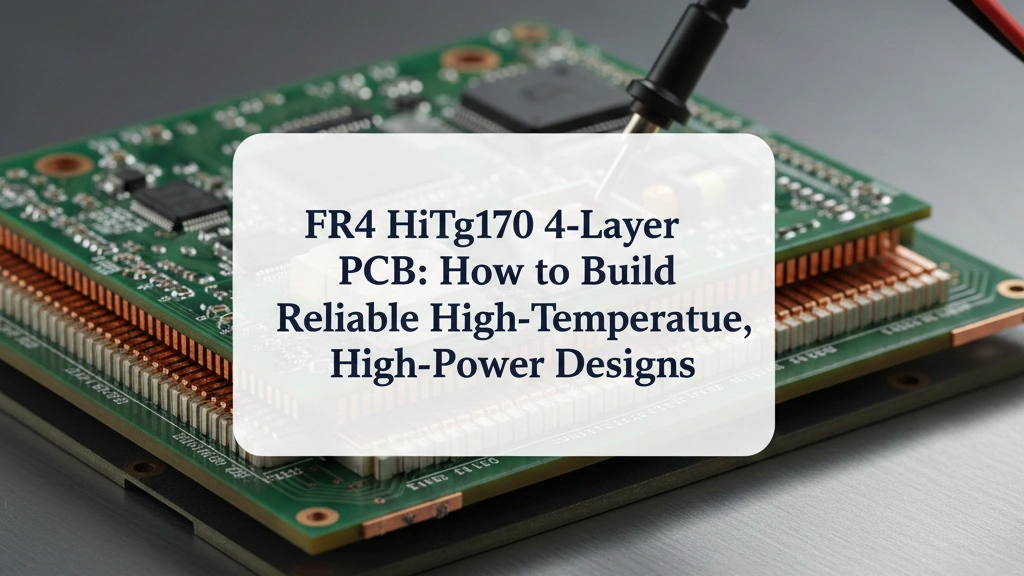
Why Should Engineering Teams Seriously Evaluate FR4 HiTg170 4-Layer PCBs?
Engineering teams working on motor control, power conversion, automotive controllers, LED drivers and telecom equipment are constantly fighting a triple constraint: high temperature, high power density and aggressive cost targets. In many of these applications, the environment sits in the 80–125 °C range for long periods, while boards must survive multiple lead-free reflow or wave-solder cycles. Standard FR4 grades that were acceptable for legacy designs often start to show their limits under these conditions, especially when combined with higher assembly temperatures and dense BGA or QFN packages. A move to FR4 HiTg170 with a controlled 4‑layer stackup is therefore less about “premium material” and more about aligning the PCB platform with the realities of modern high-reliability electronics.
Procurement managers face a related set of challenges. Customers and internal quality teams expect automotive-style robustness—traceable materials, consistent stackups and stable warpage behaviour—without wanting to pay for exotic substrates on every project. A supplier that understands high‑Tg laminates, 1oz copper multi‑layer processing and automotive-grade quality systems can bridge this gap. Instead of sourcing from multiple vendors with inconsistent process capability, buyers can standardize critical projects on a predictable FR4 HiTg170 4‑layer platform while reserving more specialized materials for edge cases. This shift simplifies qualification, reduces the risk of field failure and supports long-term supply continuity.
For organizations working with Jerico, the evaluation is not just about whether HiTg170 is technically adequate—it clearly is for many high-temperature use cases—but whether the total solution balances reliability and cost. By combining factory-direct manufacturing, no minimum order quantity and 24‑hour fast-turn capability, Jerico enables teams to validate HiTg170 stackups early in development instead of deferring material decisions until late-stage testing. That approach gives both engineers and buyers hard data on thermal margins, warpage and solder joint integrity before they commit to volume, turning material choice into a measured decision rather than a last-minute reaction to failures.
Why Does Standard FR4 Struggle Under High Temperature and Lead-Free Soldering?
As assembly temperatures have risen with the adoption of lead-free solders, the margin between laminate glass transition temperature and peak reflow temperature has narrowed for many designs. Standard FR4 materials with lower Tg values can soften significantly during reflow, causing increased z‑axis expansion and stress on copper barrels and interconnects. When boards are populated with fine‑pitch BGAs or QFNs, even slight warpage or differential expansion can translate into solder joint fatigue, head‑in‑pillow defects or intermittent opens that are difficult to diagnose. Repeated thermal cycling in the field compounds these effects, especially in automotive or industrial environments where temperature swings are large and frequent.
High-power modules and motor drives amplify the problem. Copper pours carrying large currents generate local heating, while nearby components may also dissipate significant power. If the base laminate cannot maintain structural integrity at elevated temperatures, the risk of delamination, resin recession or conductive anodic filament growth increases. Designers sometimes respond by over‑thickening copper or stacking multiple boards together, but these workarounds add cost, weight and mechanical complexity without addressing the underlying material mismatch. They can also create new reliability issues by introducing larger thermal gradients, making some regions of the assembly much hotter than others.
Supply-chain weaknesses can turn these technical limits into expensive surprises. Vendors that lack experience with high‑Tg laminates and 1oz 4‑layer constructions may produce acceptable samples at small scale but struggle with warpage, via reliability or resin consistency when volumes ramp. If early qualification tests are run on boards that do not reflect the true mass-production process, teams may sign off on a design only to face field returns later. For this reason, material choice, stackup design and supplier capability must be considered together. Moving to FR4 HiTg170 with a supplier that routinely handles high‑temperature, high‑power projects is often the most economical way to eliminate these hidden costs.
What Makes FR4 HiTg170 a Strong Fit for High-Temperature, High-Reliability Applications?
What Are the Key Material Advantages of High-Tg FR4 Around 170 °C?
High‑Tg FR4 in the 170 °C class is designed to stay mechanically stable at temperatures where standard FR4 begins to soften. The higher glass transition temperature reduces the degree of z‑axis expansion during lead‑free reflow and subsequent thermal cycling. This directly lowers the mechanical stress on plated through holes and copper barrels, where cracks can otherwise initiate and propagate over time. Improved interlaminar adhesion and optimized resin systems further reduce the risk of delamination or resin recession at copper features, particularly around BGA pads and via-in-pad structures subjected to repeated heating.
Another important characteristic is the lower coefficient of thermal expansion in the z‑direction compared with standard FR4 grades. A reduced CTE means that, for a given temperature rise, the material expands less in thickness, again decreasing strain on interconnects and solder joints. When designs operate continuously in the 100–125 °C range, as is common in under‑hood automotive, industrial drives or LED lighting, this difference accumulates over thousands of hours and many thermal cycles. The material’s electrical properties—such as dielectric strength and insulation resistance—also remain more stable at elevated temperatures, which helps maintain creepage and clearance performance and reduces the chance of leakage or breakdown.
These features make HiTg170 FR4 particularly attractive for high‑power motor control boards, inverter stages, battery management systems and control units subjected to both thermal and mechanical stress. In automotive environments, for example, engine control units, transmission controllers and ADAS submodules often see a combination of vibration, temperature cycling and exposure to automotive fluids. Similar challenges appear in industrial servo drives and solar inverters, where boards reside near power semiconductors and heat sinks. High‑brightness LED drivers and stage lighting equipment also benefit from a substrate that can handle both ambient heat and self‑heating without slowly deforming or degrading.
How Does a 4-Layer Stack with 1oz Copper Improve Signal and Power Integrity?
A thoughtfully designed 4‑layer stackup transforms HiTg170 FR4 from a robust mechanical platform into a powerful system‑level tool for managing signal fidelity, power distribution and electromagnetic emissions. A common architecture places critical high‑speed or sensitive signals on one outer layer, with a continuous ground plane directly beneath it, while the second inner layer is reserved for power distribution or high‑current paths. The remaining outer layer can then host additional signals, connectors and less critical routing. This tight coupling between signal layers and reference planes reduces impedance discontinuities, minimizes loop areas and lowers susceptibility to crosstalk, particularly in mixed‑signal and power‑dense designs.
The choice of 1oz copper on these layers adds both electrical and thermal benefits. Compared with 0.5oz copper, 1oz copper can carry higher currents for a given trace width, providing greater safety margins without resorting to extremely wide tracks that consume board real estate. In power planes and ground planes, thicker copper reduces the overall impedance of the power distribution network, leading to lower voltage droop and improved transient response. It also acts as an effective heat spreader, helping to distribute localized hot spots away from high‑dissipation components such as MOSFETs, IGBTs and regulators.
From an EMI perspective, placing solid ground and power planes in the stack helps contain return currents and provides shielding between noisy and sensitive circuits. When combined with high‑Tg material that maintains dimensional stability under heat, the designed impedance and layer‑to‑layer spacing remain consistent across production lots and operating conditions. This stability is essential for interfaces like CAN, Ethernet, LVDS and various high‑speed serial links that may share the same board as high‑dI/dt power stages. In practice, a HiTg170 4‑layer, 1oz stackup offers a well-balanced compromise: robust enough for demanding high‑temperature environments, but still cost‑effective compared with exotic substrates or much thicker copper constructions.
How to Use FR4 HiTg170 4-Layer Boards to Build a High-Temperature, High-Reliability System?
How to Approach Stackup and Layout for HiTg170 4-Layer Designs?
Successful HiTg170 4‑layer designs start with a clear understanding of the thermal, electrical and mechanical requirements. Early in the design process, it is helpful to capture basic parameters in a checklist-style format: expected ambient and hotspot temperatures, maximum continuous and peak currents per net, voltage isolation requirements and any relevant industry standards or customer specifications. With this information, the stackup can be defined so that critical signals always have a solid reference plane beneath them, and high‑current or noisy nets are routed on layers that allow short, wide paths and well‑distributed return currents. Working closely with the PCB manufacturer at this stage is important, because achievable dielectric thicknesses and copper weights influence both impedance control and warpage behaviour.
In terms of layout, high‑temperature environments demand extra attention to current density and thermal spreading. Power traces should use wider widths and soft corners rather than sharp bends, minimizing local hotspots and mechanical stress. Copper pours around power devices can be tied to inner planes through arrays of thermal vias, providing a low‑impedance path for both current and heat. Careful placement of components relative to heat sinks, airflow paths or enclosure walls further improves cooling efficiency. For high‑speed or precision analog signals, consistent reference plane coverage and controlled impedance routing are essential. Whenever possible, critical differential pairs and single‑ended high‑speed nets should run over uninterrupted ground areas, with layer changes minimized or executed via well‑designed via transitions.
Collaboration with the fabrication partner helps ensure that theoretical design goals translate into robust manufacturing outcomes. Topics such as allowable aspect ratios for plated through holes, tolerances for dielectric thickness, and minimum spacing between copper features and board edges all affect long‑term reliability. In a high‑temperature context, small deviations in these parameters can magnify stress on vias and pads. Jerico’s engineering team can provide concrete recommendations on via sizing, copper balancing across the board and panelization strategies that promote flatness during reflow. Treating the stackup and layout as a joint engineering exercise rather than a one‑way specification improves the odds of first‑time‑right performance in both prototypes and mass production.
How to Coordinate HiTg170 Material with Lead-Free Soldering Processes?
Even when the laminate is well suited to high temperatures, success depends on how it is integrated with lead‑free assembly processes. HiTg170 FR4 can tolerate the higher peak temperatures and longer dwell times associated with lead‑free reflow, but each product still needs an appropriate thermal profile. Overly aggressive profiles may not damage the laminate immediately but can accelerate long‑term degradation or stress vias unnecessarily. Overly conservative profiles, on the other hand, may lead to insufficient wetting or incomplete reflow at dense BGA sites. Coordinating profile development between the PCB manufacturer, the assembly house and the design team helps to avoid these extremes.
For boards using BGA, QFN or fine‑pitch components, warpage control becomes critical. HiTg170’s lower z‑axis expansion and better adhesion reduce the risk of board deformation during reflow, but panel design, copper balancing and component distribution also play important roles. Simulations and empirical testing can be used to identify areas where warpage may be highest, prompting adjustments such as relocating heavy components, altering copper distribution or refining panel break‑off features. It is especially important to test multiple reflow cycles if the board will go through both reflow and wave solder, or double‑sided assembly, to verify that accumulated stress remains within acceptable limits.
Jerico supports this coordination by combining material expertise with rapid prototype capability. With 24‑hour fast‑turn options for suitable designs, teams can quickly validate how their HiTg170 4‑layer stackup behaves under the intended lead‑free profiles, adjusting pad designs, thermal relief patterns or stencil apertures as needed. The company’s quality system—built around ISO9001, IATF16949, UL recognition and IPC‑driven process control—ensures that the conditions used for early trials carry over into volume production. This continuity is especially important for automotive and industrial customers, who need evidence that solder joint and via reliability was evaluated under realistic process windows rather than laboratory‑only conditions.
Why Does a Factory-Direct FR4 HiTg170 4-Layer Solution Reduce Project Risk?
Why Is “Where You Buy” More Critical Than “What You Buy” for HiTg170 Boards?
In high‑reliability electronics, selecting the right material is only half the story; ensuring that it is processed consistently and documented properly is equally important. A factory‑direct relationship with a PCB manufacturer that routinely handles HiTg170 and multi‑layer boards closes the gap between design intent and shop‑floor reality. Engineers can discuss stackup details, via structures, copper weights and impedance targets directly with the people responsible for lamination cycles, drilling and plating. This reduces the risk of misinterpretation that can occur when specifications pass through intermediaries who may not fully understand the nuances of high‑Tg processing.
Capacity and scheduling reliability are critical for projects with tight validation timelines. Jerico’s monthly output of around 60,000 m² provides enough headroom to support both complex high‑Tg multi‑layer builds and smaller engineering lots without constant schedule conflicts. That scale allows the company to maintain stable process windows and to allocate dedicated resources to NPI and fast‑turn work. For customers, this means fewer surprises in lead time, easier planning of design‑build‑test cycles, and a realistic path from trial builds to sustained production. When the same factory manages both phases, there is no need to re‑qualify a second supplier or repeat expensive validation when volumes grow.
The quality infrastructure behind the boards matters just as much. Jerico’s adherence to IATF16949-style practices and UL-recognized materials allows high‑temperature projects to fit into automotive and industrial qualification frameworks more smoothly. For demanding programs, additional measures—such as targeted thermal stress testing, warpage measurement, peel strength evaluation and detailed cross‑section analysis—can be planned from the outset. This project‑level scaling of quality controls provides a clear audit trail and gives customers confidence that the risk profile of their HiTg170 4‑layer solution has been objectively assessed rather than assumed.
How Do Jerico’s Product Platforms Support Future Scaling Beyond FR4 HiTg170?
A HiTg170 4‑layer board is often the right starting point for high‑temperature, high‑power projects, but some applications eventually require even more specialized solutions. Jerico’s product portfolio is designed to make such transitions smooth. For many high‑temperature controllers and power modules, the base technology is rigid FR4, described in detail at https://pcbjust.com/product/rigid-pcb/. When the same application demands higher routing density or tighter packaging, HDI structures, available via https://pcbjust.com/product/hdi-pcb/, can introduce microvias and fine lines while still leveraging high‑Tg laminates.
As current levels rise or power stages become more compact, heavy copper designs—supported at https://pcbjust.com/product/heavy-copper-pcb/—provide thicker copper foils capable of carrying larger currents without excessive temperature rise. When thermal demands exceed what FR4 can reasonably handle, ceramic and metal‑core PCBs, accessible via https://pcbjust.com/product/ceramic-pcb/ and https://pcbjust.com/product/metal-pcb/, offer much higher thermal conductivity and more direct heat‑spreading paths. For applications that combine high temperature with the need for compact, three‑dimensional layouts or integrated RF functions, rigid‑flex, cavity and high‑frequency PCB technologies—described at https://pcbjust.com/product/rigid-flex-pcb/, https://pcbjust.com/product/cavity-pcb/ and https://pcbjust.com/product/high-frequency-pcb/—provide further evolution paths.
The advantage of this integrated ecosystem is that teams can grow their designs without repeatedly changing partners. Lessons learned from the initial FR4 HiTg170 4‑layer project—about thermal margins, mechanical constraints and assembly behaviour—can be carried into the design rules and stackups of more advanced boards. Procurement benefits from continuity in contracts and audit processes, while engineering retains a familiar communication channel for discussing trade‑offs and optimization. In effect, the HiTg170 4‑layer platform becomes a gateway to a scalable technology roadmap rather than an isolated solution.
How Can a Real-World High-Temperature Motor Control Project Leverage FR4 HiTg170 4-Layer Boards?
Imagine an industrial motor drive or automotive traction control unit that initially used a standard FR4 multi‑layer board. Field data shows that, in certain duty cycles and under‑hood ambient conditions, the boards experience warpage, solder joint fatigue and occasional via failures after prolonged operation. Root cause analysis points to laminate softening around reflow temperatures, combined with high local heating from power semiconductors and copper pours. Simply increasing copper thickness or adding more layers would raise cost and complicate mechanical integration without guaranteeing long‑term stability.
In a redesign, the team adopts an FR4 HiTg170 4‑layer, 1oz stackup. Inner layers are dedicated to solid ground and power planes, while outer layers handle critical gate‑drive, sensing and communication signals. Jerico’s engineers work with the design team to define dielectric thicknesses and copper balancing that minimize warpage and support controlled impedance where needed. Thermal simulations guide the placement of MOSFETs, gate drivers and current shunts, and arrays of thermal vias connect hot regions to internal planes and heat sinks. During prototyping, boards undergo extended high‑temperature operation, thermal cycling and vibration testing to validate both electrical performance and mechanical robustness.
The results show a significant drop in field failure rates and improved consistency in assembly yields. The HiTg170 material maintains dimensional stability through multiple lead‑free reflow cycles, while the 1oz planes distribute heat more evenly and provide stable reference paths for sensitive signals. The supply chain also becomes simpler: instead of juggling multiple PCB vendors for different variants, the customer relies on Jerico’s factory‑direct model for both prototypes and volume production. Over time, this platform supports additional variants of the motor control product family, including versions that move selected power stages onto heavy copper or metal‑core boards, without requiring a wholesale rethinking of the design process.
How to Get Your FR4 HiTg170 4-Layer Design Reviewed and Prototyped Quickly
For engineering and procurement teams considering FR4 HiTg170 4‑layer boards for their next high‑temperature project, the most practical next step is a targeted design and stackup review. By sharing Gerber data, a brief description of the application environment and key electrical and thermal requirements, teams can receive specific recommendations on layer order, copper weights, via structures and DFM optimizations. This collaborative approach ensures that the chosen HiTg170 stackup aligns with both performance goals and manufacturing realities, and that there is a clear plan for scaling to volume if prototypes meet expectations. To start this process and obtain an initial quotation based on your actual design, you can upload your Gerber and BOM files through https://pcbjust.com/online-quote/, indicating that you are evaluating a HiTg170 4‑layer, high‑temperature solution.
FAQ: FR4 HiTg170 4-Layer PCBs for High-Temperature, High-Power Designs
What is FR4 HiTg170 and when should I consider it?
FR4 HiTg170 is a class of glass‑fiber reinforced epoxy laminates with a glass transition temperature around 170 °C, higher than standard FR4. It is recommended for designs that must endure lead‑free reflow profiles, sustained ambient temperatures above about 80 °C, or repeated thermal cycling, such as automotive controllers, industrial drives and high‑brightness LED power supplies.
How to decide between a standard FR4 and HiTg170 for my project?
Start by analysing maximum board temperature during operation and assembly. If your peak reflow temperatures and operating conditions leave only a small margin to the laminate Tg, standard FR4 may soften too much, increasing warpage and stress on vias. In such cases, HiTg170 provides extra thermal headroom and more stable mechanical behaviour. Projects subject to stringent reliability requirements or aggressive duty cycles are good candidates for HiTg170, even if they have run on standard FR4 in the past.
Why does a 4-layer, 1oz stackup make sense for high-power and automotive applications?
A 4‑layer, 1oz stackup gives enough layers to provide solid ground and power planes while keeping the construction relatively simple and cost‑effective. The planes improve signal integrity, reduce EMI and help dissipate heat from power components. The 1oz copper thickness increases current‑carrying capacity and lowers impedance compared with thinner foils, which is beneficial for power stages and low‑voltage, high‑current distribution networks.
How to ensure my HiTg170 design works with lead-free reflow and wave soldering?
Coordinate reflow and wave profiles with both the PCB manufacturer and assembly house, using the laminate’s recommended thermal limits as a reference. Validate warpage, solder joint quality and via integrity through testing that reflects the number of thermal cycles the board will see in production. Where necessary, adjust copper balance, panelization and component placement to reduce deformation during heating. Early prototypes built under realistic process conditions are essential to confirming long‑term reliability.
What is the best way to start working with Jerico on a HiTg170 4-layer project?
Prepare your Gerber files, BOM and a short description of the application environment, including target temperatures, voltages and currents. When you submit an online quote request, specify that you are evaluating FR4 HiTg170 with a 4‑layer, 1oz stackup. Jerico’s engineering team can then review your design, suggest stackup and layout optimizations and propose a prototype plan that fits both performance and schedule constraints.